
Solar
How Solar Energy Works: A Complete Beginner’s Introduction to Solar Panels
A beginner-friendly explanation of solar panels, inverters, batteries, system types, performance, costs and practical questions before installation.
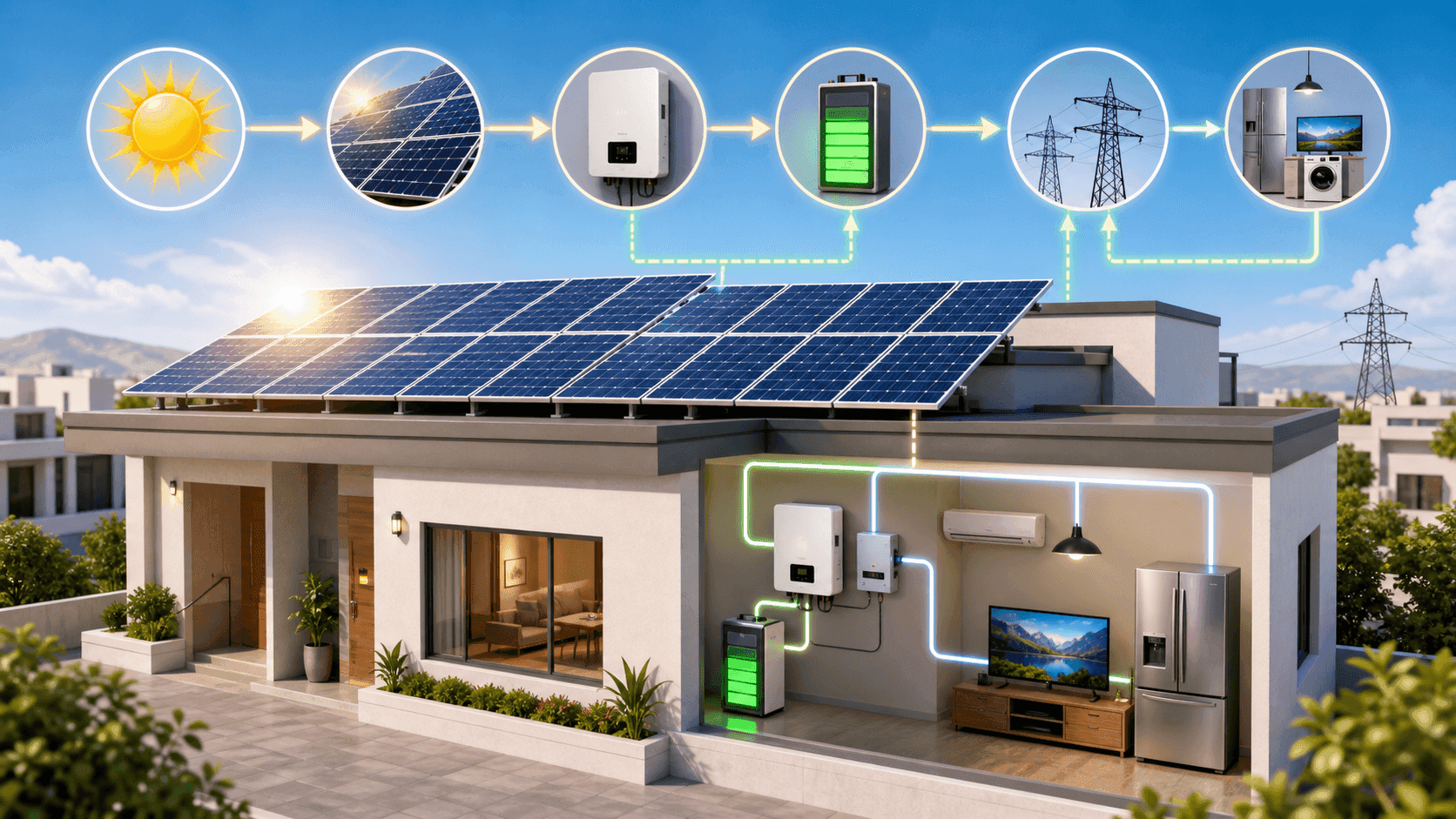
Solar energy sounds complicated until someone explains it without turning the explanation into an electrical-engineering lecture.
At its simplest, a solar panel receives sunlight and converts it into electricity. An inverter then converts that electricity into a form your home or business can use.
But that simple explanation leaves plenty of questions:
- How do solar panels generate electricity?
- Do solar panels work at night or on cloudy days?
- What equipment does a complete solar system require?
- What is the difference between on-grid, off-grid, and hybrid solar systems?
- How many solar panels does a home need?
- Are batteries necessary?
- How long do solar panels last?
- Is solar energy really worth the investment?
This blog answers these questions and explains the complete journey from sunlight hitting a solar panel to electricity powering your appliances.
If you are learning before making a purchase decision, start with the solar system size calculator so offers can be compared against the same assumptions.
What Is Solar Energy?
Solar energy is the light and heat produced by the Sun.
People have used the Sun’s energy for centuries to warm buildings, dry crops, heat water, and preserve food. Modern solar technology allows us to convert sunlight directly into usable electricity.
There are two common ways to use solar energy:
- Solar photovoltaic technology converts sunlight into electricity.
- Solar thermal technology captures heat from sunlight for water or space heating.
When people talk about installing solar panels on a home, they usually mean a solar photovoltaic system, commonly called a solar PV system.
How Do Solar Panels Work?
Solar panels generate electricity through a process known as the photovoltaic effect.
Here is the basic process:
- Sunlight reaches the solar panels.
- Solar cells inside the panels absorb particles of sunlight called photons.
- The absorbed energy causes electrons inside the cells to move.
- This movement produces direct-current electricity.
- An inverter converts direct current into alternating current.
- The converted electricity powers the building’s appliances.
- Extra electricity may charge batteries or be exported to the electrical grid.
The process happens silently and does not require fuel to be burned.
Let us examine each step more closely.
What Is the Photovoltaic Effect?
The photovoltaic effect is the process through which certain materials generate an electrical current after being exposed to light.
Most solar cells are made from silicon. Silicon is a semiconductor, meaning its electrical behaviour falls between that of a conductor and an insulator.
During manufacturing, silicon is treated to create two differently charged layers:
- One layer has a negative electrical charge.
- The other layer has a positive electrical charge.
When sunlight hits the solar cell, its photons transfer energy to electrons in the silicon. Some electrons become free and begin moving through the electrical field created between the two layers.
Metal conductors collect these moving electrons and direct them into a circuit.
The electricity produced at this stage is called direct current, or DC electricity.
What Is the Difference Between DC and AC Electricity?
Solar panels produce direct-current electricity, but most homes and businesses use alternating-current electricity.
In direct current, electricity flows in one direction. Batteries and solar panels normally operate using DC electricity.
In alternating current, the direction of the electrical flow changes repeatedly. Electrical grids and most household appliances operate using AC electricity.
A solar inverter performs the important job of converting DC electricity from the panels into AC electricity that can be used by:
- Lights
- Fans
- Refrigerators
- Air conditioners
- Televisions
- Computers
- Water pumps
- Other household and commercial appliances
Without an inverter, the electricity produced by conventional solar panels cannot directly power most household equipment.
What Happens to the Electricity Generated by Solar Panels?
The answer depends on the type of solar system installed.
Solar electricity can be:
- Used immediately by the building
- Stored inside batteries
- Exported to the electrical grid
- Combined with electricity received from the grid
A solar system does not necessarily supply every appliance directly from the panels at every moment. Its inverter continuously manages available solar production, electricity consumption, battery status, and grid availability.
If the panels are producing more electricity than the building requires, the additional energy may charge the batteries or be sent to the grid.
If the building requires more electricity than the panels are producing, the difference may come from batteries or the grid.
What Are the Main Types of Solar Systems?
Residential and commercial solar installations generally fall into three categories:
- On-grid solar systems
- Off-grid solar systems
- Hybrid solar systems
Each type solves a different problem.
What Is an On-Grid Solar System?
An on-grid system, also called a grid-tied system, remains connected to the public electricity network.
During sunny hours, the building uses electricity generated by its solar panels. If the panels cannot produce enough electricity, the building draws the remaining power from the grid.
When the solar panels produce more electricity than the building consumes, the surplus may be exported to the grid where local rules and utility infrastructure permit it.
Advantages of an On-Grid System
- Usually costs less because batteries are not required
- Can reduce electricity purchased from the grid
- Makes use of the grid when solar production is insufficient
- Generally requires less maintenance than a battery-based system
Disadvantages of an On-Grid System
- A normal grid-tied inverter usually shuts down during a power outage
- It does not provide backup power unless compatible batteries and backup equipment are installed
- Exporting electricity depends on local grid-export policies and utility approval
People are sometimes surprised that their solar panels stop providing power during a grid outage. This shutdown is a safety feature designed to prevent solar electricity from flowing into power lines while technicians may be repairing them.
What Is an Off-Grid Solar System?
An off-grid system operates independently from the public electrical grid.
It normally includes:
- Solar panels
- An off-grid inverter
- A battery bank
- Charge-control equipment
- Safety devices
- Sometimes a backup generator
During the day, solar panels power appliances and charge the batteries. At night or during poor weather, electricity is supplied by the stored battery energy.
Advantages of an Off-Grid System
- Can provide electricity in remote locations
- Does not depend on the public grid
- Offers complete energy independence when designed correctly
- Can be useful where grid connections are unavailable or unreliable
Disadvantages of an Off-Grid System
- Batteries significantly increase the installation cost
- The system must be carefully designed around expected energy consumption
- Long periods of poor sunlight can reduce available power
- Batteries eventually require replacement
- Users may need to manage their electricity consumption more carefully
An off-grid system should not be designed using only average daily consumption. It must also account for peak loads, poor-weather days, battery discharge limits, and future energy requirements.
What Is a Hybrid Solar System?
A hybrid system combines solar panels, battery storage, and a grid connection.
It can use solar electricity during the day, store extra electricity in batteries, draw from the grid when necessary, and provide backup power during an outage.
Advantages of a Hybrid System
- Provides backup power
- Allows solar energy to be used after sunset
- Reduces dependence on the grid
- Offers greater flexibility in managing energy
- Can prioritize solar, batteries, or grid electricity according to the user’s needs
Disadvantages of a Hybrid System
- Costs more than a basic on-grid system
- Requires compatible batteries and an appropriate hybrid inverter
- Has more components to configure and maintain
- Poor system design can cause unnecessary battery cycling and reduce battery life
Hybrid systems are attractive in places where electricity prices are high or power outages are common. However, adding batteries does not automatically make a solar installation better. The additional cost should be justified by backup requirements and expected energy savings.
What Components Are Required for a Solar System?
Solar panels are the most visible part of a solar installation, but they are not the complete system.
A typical solar system can include:
- Solar panels
- Solar inverter
- Mounting structure
- Electrical wiring
- DC and AC protection devices
- Earthing and surge protection
- Energy meter
- Performance-monitoring system
- Batteries
- Charge controller
- Backup generator
The exact equipment depends on whether the system is on-grid, off-grid, or hybrid.
Solar Panels
A solar panel contains multiple photovoltaic cells connected together and protected by several layers.
A typical panel includes:
- Silicon solar cells
- Tempered front glass
- Encapsulating material
- Protective backsheet
- Metal frame
- Electrical conductors
- Junction box
- Connection cables
The front glass allows sunlight to reach the solar cells while protecting them from rain, dust, wind, and physical damage.
Modern solar panels are designed for long-term outdoor use, but installation quality remains important. A good panel installed with weak mounting, poor wiring, or inadequate protection can still become unreliable or unsafe.
Monocrystalline vs Polycrystalline Solar Panels
Solar panels are often classified as monocrystalline or polycrystalline.
Monocrystalline Solar Panels
Monocrystalline cells are made using a single silicon-crystal structure.
They usually offer:
- Higher efficiency
- Better power output for limited roof space
- A dark and uniform appearance
- Better performance per square metre
They may also cost more than lower-efficiency alternatives.
Polycrystalline Solar Panels
Polycrystalline cells are made from multiple silicon fragments melted together.
They traditionally offer:
- A lower purchase price
- Slightly lower efficiency
- A blue or less uniform appearance
- A larger area requirement for the same total output
Monocrystalline technology now dominates many markets because improved manufacturing has reduced its cost. However, panel quality cannot be judged by cell type alone.
Warranty terms, manufacturer reliability, efficiency, degradation rate, temperature coefficient, certification, and local support also matter.
What Does a Solar Inverter Do?
The inverter is one of the most important components of a solar installation.
Its primary job is to convert DC electricity from the solar panels into AC electricity. Modern inverters may also:
- Monitor solar-panel output
- Manage battery charging and discharging
- Synchronize with the electrical grid
- Detect electrical faults
- Shut down the system when unsafe conditions occur
- Provide system-performance information
- Control where electricity comes from and where it goes
Common Types of Solar Inverters
String Inverter
Multiple solar panels are connected together in a series called a string. The string supplies electricity to one central inverter.
String inverters are widely used because they are relatively simple and cost-effective.
However, shade or poor performance affecting one panel can reduce the output of the connected string, depending on the design.
Microinverter
A small inverter is installed behind each solar panel.
Microinverters allow panels to operate more independently and can be useful where different panels experience different levels of sunlight or face different directions.
They also provide panel-level monitoring, but the initial cost can be higher.
Off-Grid Inverter
An off-grid inverter operates without relying on the public electricity network. It normally works with batteries and must be sized to handle the building’s expected load.
Hybrid Inverter
A hybrid inverter manages solar panels, batteries, grid electricity, and sometimes a generator through one system.
When selecting an inverter, consider its rated capacity, surge handling, efficiency, supported battery types, monitoring options, warranty, and after-sales support.
Solar Mounting Structure
The mounting structure secures solar panels to a roof, wall, carport, or the ground.
It must withstand:
- Wind
- Rain
- Heat
- Corrosion
- The weight of the panels
- Long-term exposure to outdoor conditions
A mounting structure also positions panels at a suitable direction and angle for sunlight.
Common mounting options include:
- Sloped-roof mounting
- Flat-roof mounting
- Ground-mounted structures
- Carport structures
- Adjustable seasonal mounts
- Motorized solar trackers
Solar trackers follow the Sun during the day, but their additional cost, maintenance, and moving parts mean they are not automatically the best option for every property.
For many residential installations, a properly designed fixed structure is the simpler choice.
Solar Batteries
Solar batteries store electricity for later use.
They can supply power:
- At night
- During a grid outage
- When solar production is lower than consumption
- During expensive electricity periods, where time-based tariffs apply
Common battery categories include:
- Lead-acid batteries
- Tubular batteries
- Gel batteries
- Lithium-ion batteries
- Lithium iron phosphate batteries
Lithium iron phosphate batteries are popular in modern solar systems because they generally offer deeper usable capacity, longer cycle life, and lower maintenance than traditional lead-acid batteries.
However, they normally cost more initially.
Battery capacity alone does not tell the full story. Buyers should also consider:
- Usable capacity
- Depth of discharge
- Cycle life
- Charge and discharge rate
- Battery-management system
- Operating temperature
- Warranty
- Compatibility with the inverter
A 10 kWh battery may not provide 10 kWh of usable electricity if its recommended discharge limit reserves part of that capacity.
Solar Wiring and Protection Equipment
Solar electricity must be handled safely.
A properly installed system may require:
- DC cables
- AC cables
- Circuit breakers
- DC isolators
- AC isolators
- Fuses
- Surge-protection devices
- Earthing
- Lightning protection
- Combiner boxes
- Correctly rated connectors
This equipment may not look exciting, but it protects people, appliances, solar panels, and the building.
Cheap cables, undersized breakers, poor-quality connectors, and weak earthing can create serious safety and performance problems.
The number of solar panels printed on a quotation should never be the only thing a buyer compares.
Solar Monitoring System
Most modern inverters include an application or online dashboard for monitoring performance.
A monitoring system may show:
- Current solar production
- Daily energy production
- Total energy generated
- Household consumption
- Battery charge level
- Grid import and export
- System faults
- Historical performance
Monitoring helps users notice problems early.
If production suddenly falls on a clear day, the cause could be shading, dust, a disconnected string, an inverter error, or another electrical issue.
Without monitoring, the system may continue underperforming for weeks before anyone notices.
How Are Solar Panels Made?
Solar-panel manufacturing begins with silicon, one of the most abundant elements found in the Earth’s crust.
However, the silicon used in solar cells must be highly purified.
The general manufacturing process includes the following steps.
1. Purifying the Silicon
Raw silicon material is processed at high temperatures to produce the purity required for photovoltaic cells.
2. Creating Silicon Ingots
The purified silicon is melted and formed into solid ingots.
The manufacturing method determines whether the final cells have a monocrystalline or polycrystalline structure.
3. Cutting the Wafers
The ingots are sliced into very thin wafers.
These wafers form the base of individual solar cells.
4. Creating the Electrical Layers
The wafers are treated with selected materials to create positively and negatively charged regions.
These regions produce the electrical field required for the photovoltaic effect.
5. Applying an Anti-Reflective Coating
Untreated silicon reflects part of the sunlight that reaches it.
An anti-reflective coating helps the cell absorb more light and improves electricity production.
6. Adding Electrical Contacts
Thin metal conductors are added to collect and carry the electrical current generated by the cell.
7. Connecting the Cells
Multiple solar cells are connected to create a solar-panel circuit.
8. Assembling the Panel
The connected cells are placed between protective layers, covered with tempered glass, sealed against moisture, and supported by a metal frame.
A junction box and cables are added to allow the panel to connect with other panels and system equipment.
9. Testing the Finished Panel
Manufacturers test panels for electrical output, insulation, durability, and visible defects.
Panels may also be assigned power ratings based on their measured performance under standardized test conditions.
Do Solar Panels Work on Cloudy Days?
Yes, solar panels work on cloudy days because some sunlight still reaches the Earth’s surface.
However, they normally generate less electricity than they would under strong, direct sunlight.
The reduction depends on:
- Cloud density
- Panel technology
- Temperature
- Time of day
- Shading
- Panel direction and angle
A cloudy day does not necessarily mean zero production. It means lower and less predictable production.
This is one reason solar systems are designed using historical sunlight data rather than assuming perfect sunshine every day.
Do Solar Panels Work at Night?
No. Solar panels do not produce electricity at night because there is no sunlight available for the photovoltaic process.
At night, a solar-powered building receives electricity from:
- The electrical grid
- Solar batteries charged during the day
- A backup generator
- Another energy source
Statements suggesting that ordinary solar panels generate meaningful electricity from moonlight should be treated with healthy suspicion. Moonlight is reflected sunlight, but its intensity is far too low for normal practical solar production.
Do Solar Panels Work During a Power Outage?
It depends on the system.
A standard on-grid system usually switches off during an outage for safety.
A hybrid or off-grid system can continue providing electricity if:
- It includes compatible backup equipment
- Batteries contain sufficient energy
- The inverter supports backup operation
- Essential loads are wired correctly
Even with batteries, a solar system may not power every appliance during an outage. Many systems use a separate essential-load circuit for equipment such as lights, fans, internet devices, security systems, and selected refrigerators.
Heavy appliances can quickly drain batteries or exceed the inverter’s power rating.
How Is a Solar System Designed?
A solar system should be designed around two central questions:
- How much electricity is required?
- How much suitable space is available?
A professional design also considers:
- Monthly electricity consumption
- Daily energy requirements
- Peak electrical load
- Roof size and condition
- Panel direction
- Panel angle
- Shade from nearby objects
- Local weather
- Inverter capacity
- Battery-backup duration
- Future electricity needs
- Electrical safety
- Grid-connection rules
- Installation budget
Buying the largest system you can afford is not always the correct strategy. The system should match the problem you want it to solve.
How Many Solar Panels Does a Home Need?
The required number of panels depends on energy consumption and the wattage of each panel.
A basic estimate can be made using:
Required system size =
Daily electricity consumption ÷ Average peak sunlight hours
System losses must then be added because panels rarely operate at their laboratory-rated output throughout the day.
For example, suppose a home consumes 20 kWh of electricity per day and receives an average of five useful peak-sun hours:
20 kWh ÷ 5 hours = 4 kWAfter accounting for system losses, weather, temperature, wiring, inverter efficiency, and panel orientation, the required solar capacity would be higher than the simple 4 kW result.
If 550-watt panels are selected, the number of panels can be estimated using:
Number of panels =
Required solar capacity ÷ Individual panel capacity
This is only an initial estimate.
A proper design should use actual electricity bills, local solar conditions, available space, appliance loads, and expected consumption patterns.
What Affects Solar-Panel Performance?
The amount of electricity generated by a solar system depends on more than the panel’s printed wattage.
Important factors include:
- Sunlight intensity
- Panel direction
- Panel angle
- Shading
- Temperature
- Dust and dirt
- Panel efficiency
- Inverter efficiency
- Cable losses
- Panel degradation
- System design
- Equipment quality
Shading
Shade from a tree, wall, water tank, antenna, or nearby building can significantly affect production.
Even partial shade on one panel may reduce the output of a connected string. The exact effect depends on panel design, bypass diodes, inverter configuration, and whether optimizers or microinverters are used.
Temperature
Solar panels need sunlight, but excessive heat can reduce their electrical efficiency.
A panel may produce less power on an extremely hot afternoon than its laboratory rating suggests, even under strong sunlight.
The temperature coefficient listed on a panel’s specification sheet indicates how its output changes as cell temperature rises.
Dust and Dirt
Dust, bird droppings, leaves, and pollution can block sunlight.
Cleaning requirements depend on local weather, roof angle, dust levels, and rainfall. Panels should be cleaned safely and according to the manufacturer’s recommendations.
Direction and Angle
Panels produce the most energy when they receive strong sunlight for a large part of the day.
The best direction and angle depend on the property’s location, roof design, surrounding shade, and seasonal energy requirements.
There is no single perfect angle for every country and every building.
How Long Do Solar Panels Last?
Quality solar panels are commonly designed to operate for 25 years or longer.
This does not mean they suddenly stop working after 25 years. Their output gradually decreases over time through a process called degradation.
Manufacturers often provide:
- A product warranty covering manufacturing defects
- A performance warranty covering expected long-term output
Other system components may have shorter service lives.
Inverters may require repair or replacement before the panels do, while battery life varies greatly according to battery chemistry, temperature, depth of discharge, charging behaviour, and usage.
When estimating the long-term cost of a solar system, consider the whole system rather than only the panels.
Is Solar Energy Renewable?
Yes. Solar energy is considered renewable because sunlight is naturally replenished and available on a continuing basis.
Solar electricity also produces no direct fuel-burning emissions while the panels are operating.
However, solar technology is not completely free from environmental impact. Energy and raw materials are required to manufacture, transport, install, and eventually recycle solar panels and batteries.
The fair comparison is not between solar energy and a system with no environmental cost. It is between solar energy and alternative methods of producing the same amount of electricity.
Over its working life, a solar system can generate far more energy than was required to manufacture it.
What Are the Main Advantages of Solar Energy?
Solar energy can offer several benefits.
Lower Electricity Bills
Using electricity generated by your own panels can reduce the amount purchased from the utility.
The actual savings depend on system size, electricity prices, daytime consumption, export policies, and financing costs.
Protection Against Rising Energy Costs
A solar system allows part of your future electricity consumption to be supplied by equipment you already own.
It does not remove every energy expense, but it can reduce exposure to increasing utility prices.
Backup Power
Hybrid and off-grid systems can provide backup electricity during outages.
The available backup depends on battery capacity, inverter power, appliance load, and solar production.
Energy Access in Remote Areas
Solar panels can generate electricity where extending the public grid would be difficult or expensive.
Low Operating Noise
Solar panels have no moving parts and operate silently. Fixed residential systems generally produce no mechanical noise from the panels themselves.
Reduced Dependence on Fossil Fuels
Solar power can reduce the amount of electricity that must be generated from coal, oil, or natural gas.
What Are the Disadvantages of Solar Energy?
Solar energy also has limitations.
High Initial Cost
Panels, inverters, batteries, structures, wiring, safety equipment, and installation create a considerable upfront expense.
Intermittent Production
Solar output changes according to the time of day, season, weather, shade, and panel condition.
Battery Costs
Batteries make solar energy available after sunset and during outages, but they increase cost and eventually require replacement.
Space Requirements
A property must have enough suitable roof or ground space for the required number of panels.
Roof Limitations
An old, weak, heavily shaded, or poorly oriented roof may require repairs or a different installation approach.
Equipment Quality Varies
Two systems advertised with the same capacity may differ considerably in equipment quality, protection, installation standards, warranties, and long-term performance.
Is Solar Energy Worth It?
Solar energy can be a good investment, but the answer depends on the property and the owner’s goals.
It is more likely to make financial sense when:
- Electricity prices are high
- The property receives adequate sunlight
- A large part of the electricity is consumed during the day
- The roof has sufficient unshaded space
- Quality equipment is available
- The installation is professionally designed
- The owner expects to use the property for several years
The financial case may be weaker when:
- The property is heavily shaded
- Electricity consumption is very low
- The roof requires major repairs
- Financing costs are excessive
- Export compensation is poor
- The quotation includes low-quality equipment
- Batteries are added without a genuine need
Do not judge a solar investment using only the promised monthly saving.
Calculate:
Simple payback period =
Total installed cost ÷ Estimated annual savings
This calculation is useful, but it should also account for:
- Maintenance
- Inverter replacement
- Battery replacement
- Financing costs
- Changes in electricity prices
- Panel degradation
- Net-metering or export rules
- Warranty coverage
Questions to Ask Before Installing Solar Panels
Before choosing a system or accepting an offer, ask:
- How was the required system size calculated?
- What annual energy production is expected?
- Was shading measured?
- Which panel and inverter models are included?
- Are the products genuine and covered by local warranties?
- What is the inverter’s continuous and surge capacity?
- Which appliances will work during an outage?
- What is the battery’s usable capacity?
- Which protection devices are included?
- How will the system be earthed?
- Is performance monitoring included?
- Who handles warranty claims?
- Does the quotation include installation and approvals?
- What maintenance will be required?
- What happens if actual production is lower than estimated?
A qualified professional should explain these points clearly.
If every difficult question is answered with “do not worry,” that is usually a good reason to worry.
Frequently Asked Questions About Solar Energy
Can Solar Panels Power an Entire House?
Yes, solar panels can produce enough energy for an entire house if the system is properly sized and receives sufficient sunlight.
However, powering a house over a full day is different from supplying every appliance simultaneously. The inverter must handle the peak load, while batteries or the grid must provide electricity when solar production is insufficient.
Can I Use Solar Panels Without Batteries?
Yes. On-grid solar systems commonly operate without batteries.
They provide solar electricity during the day and use the grid when solar production is unavailable. However, a normal on-grid system will not provide backup power during an outage.
Which Is Better: On-Grid or Hybrid Solar?
On-grid solar is generally more economical when the grid is reliable and the main goal is reducing electricity bills.
Hybrid solar is more suitable when backup power and energy storage are important.
The better choice depends on the user’s requirements, not on which system has more equipment.
Do Solar Panels Need Direct Sunlight?
Solar panels work best in direct sunlight, but they can also generate electricity from indirect sunlight.
Production will be lower during cloudy weather, shade, or poor atmospheric conditions.
Do Solar Panels Require Maintenance?
Solar panels usually require limited maintenance, but the system should still be inspected periodically.
Maintenance may include:
- Cleaning panels when necessary
- Checking cables and connectors
- Inspecting the mounting structure
- Reviewing inverter alerts
- Testing protection devices
- Monitoring unusual drops in production
Can Rain Damage Solar Panels?
Quality solar panels are designed for outdoor use and should withstand normal rain.
However, poor sealing, damaged connectors, incorrect cable routing, or weak installation practices can allow moisture to cause electrical problems.
Can Hail Damage Solar Panels?
Solar panels are manufactured and tested to withstand normal environmental conditions, including a degree of hail impact.
Extremely severe hail can still damage panels, just as it can damage vehicles, roofs, and windows.
How Much Money Can Solar Panels Save?
Savings depend on:
- System size
- Solar production
- Electricity rates
- Daytime consumption
- Battery usage
- Grid-export compensation
- Equipment efficiency
- Financing costs
Any saving estimate should be based on actual electricity bills and local sunlight conditions.
What Happens to Solar Panels at the End of Their Life?
Many solar-panel materials, including glass, aluminium, copper, and silicon, can be recovered or recycled.
Recycling availability varies by location, and the solar industry still needs better collection and recycling infrastructure in many regions.
Final Thoughts
Solar energy is not magic, and it is not automatically the correct solution for every property.
It is a technology that converts sunlight into usable electricity.
A successful solar installation depends on more than buying a few panels. It requires correct calculations, suitable equipment, safe installation, realistic expectations, and proper after-sales support.
Before investing, understand:
- How much electricity you consume
- When you consume it
- Whether you need backup power
- How much suitable space is available
- Which equipment is being offered
- What the complete system will cost
- How long recovering that investment may take
Once these questions have clear answers, choosing a solar system becomes much easier.
The best solar system is not necessarily the biggest or most expensive one. It is the system designed around your real energy requirements.
Final check
Conclusion
- A beginner-friendly explanation of solar panels, inverters, batteries, system types, performance, costs and practical questions before installation.
- Solar energy sounds complicated until someone explains it without turning the explanation into an electrical-engineering lecture.
- At its simplest, a solar panel receives sunlight and converts it into electricity. An inverter then converts that electricity into a form your home or business can use.
Use a related tool
Run an estimate, then confirm serious decisions with qualified professionals.